
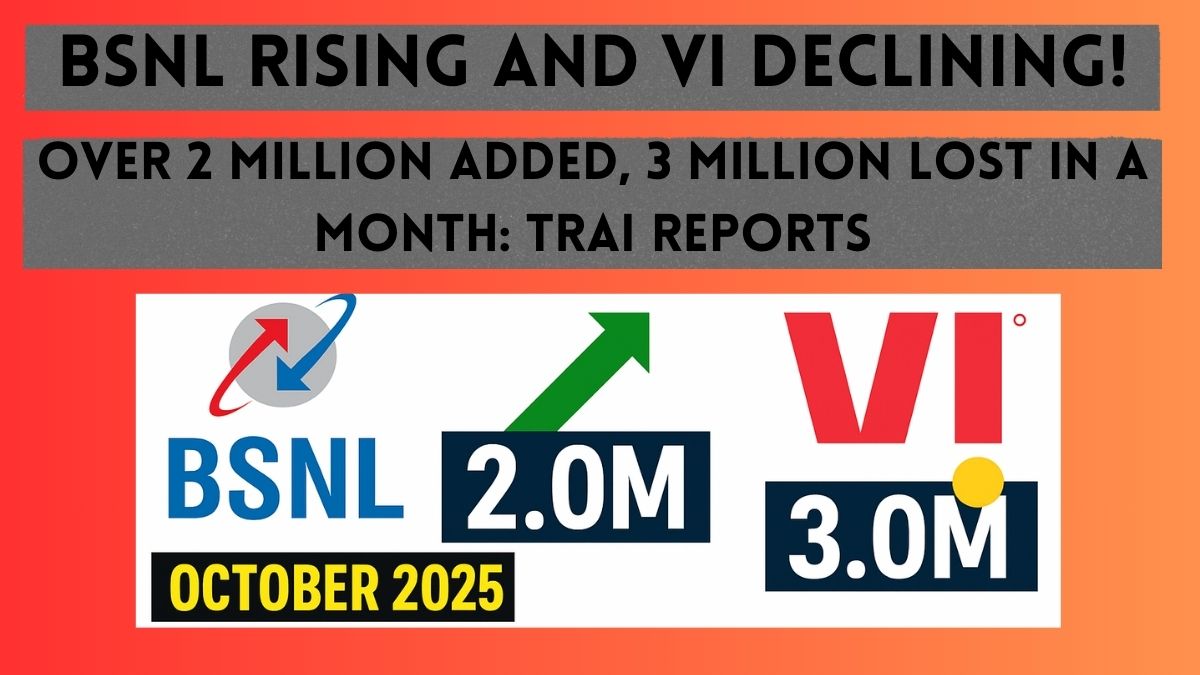
India’s telecom industry has always been a fierce battleground for competition, innovation, and customer satisfaction. However, TRAI’s most recent monthly telecom customer information has generated fresh conversations, particularly about two important players: BSNL and Vodafone Idea (Vi). One operator is seeing an unexpected increase, while the other is slipping more quickly than before. Vi lost around 3 million users within the same time period, while BSNL acquired over 2 million members, according to the research. This sharp difference clearly shows shifting consumer mood and market dynamics.
India’s total mobile and fixed wireless access connections increased by 0.19% month over month from 1182.32 million in September to 1184.62 million in October 2025, according to TRAI’s most recent data. This development, however minor, underscores the ongoing need for device connectivity nationwide. The notable narrative, however, is the uneven subscriber shifts between operators.
BSNL’s Unexpected Comeback: A Slow Giant Rising Again
Once fighting for relevance in the extremely competitive telecom industry, BSNL appears to be undergoing an unexpected comeback. Due to outdated infrastructure, a delayed rollout of 4G, and variable service quality, the public service provider lost consumers for months. The recent report, however, presents a different image. Adding almost 2 million new subscribers in a single month is no minor achievement, especially for a telco that has been dubbed “inactive” in the 4G/5G struggle.
But what’s causing this sudden growth?
Affordability is one of the best arguments. In a market where private operators are continually revising pricing upward, BSNL continues to attract price-sensitive customers with long-lasting packs and low-cost plans. Because of this, the brand has been able to win back the trust of senior residents, rural consumers, and anyone who wants reliable, drama-free access at affordable prices.
Public trust has also been restored through the government’s continuous efforts to modernise BSNL, including merger plans and the much-anticipated 4G rollout driven by domestic technology. Although BSNL’s 4G rollout is not yet nationwide, areas where network performance has improved are exhibiting encouraging subscriber trends.
Vi’s Decline Continues: An Unending Crisis
On the other side, Vodafone Idea’s continual subscriber loss is growing frighteningly. A long-term financial struggle is reflected in the loss of about 3 million customers in a single month, which points to a more serious problem than simple customer discontent. Vi has been fighting significant financial obligations, regulatory dues, and delayed network upgrades for years. Although the firm has promised 5G deployment and network enhancement, customers appear to be moving their loyalty to competitors that have already given quicker, more reliable services.
The lack of a significant rural presence and the growing user movement to Jio and Airtel’s prepaid data-heavy plans are two other significant factors contributing to Vi’s subscriber decline. In many cities, Vi still scores highly in terms of speed tests and call quality, but the variable experience between areas leads customers to switch.
Why Are Users Changing So Quickly?
The latest trends emphasise three important reasons:
- Cost vs Quality Priorities: With growing telecom prices across all operators, customers are thinking about what they genuinely need. Some favour BSNL’s inexpensive long-lasting plans, while others migrate to Jio or Airtel for premium 4G/5G services.
- Network Reliability: Even if a carrier offers attractive plans, network faults are enough to spark mass turnover. This is one of Vi’s major challenges today.
- Trust and Future Assurance: Users want operators they trust will be around for the long run. Uncertainty about Vi’s financial future makes users wary, while government-owned BSNL is earning fresh trust.
What does this signify for the Future of Telecom in India?
These changing subscriber figures suggest that India’s telecom market may be changing. BSNL may once more emerge as a serious third rival if it maintains its upward growth with aggressive 4G expansion and upcoming 5G rollout. Meanwhile, Vi badly needs funding, network upgrades, and a stronger recovery strategy if it wants to remain relevant.
The upcoming months will be critical. TRAI’s next reports may reveal if BSNL’s growth is constant or temporary and whether Vi can stop the bleeding before it’s too late.